Tree vegetable
forms
hybrids
uses
growing
using
Wednesday, May 25, 2011


Wednesday, May 18, 2011
A Garden in Bali
A Garden in Bali Part 1
Up in the mountains of Bali are a number of sleepy villages nestled among the mixed Clove, coffee and chocolate forests. They are mostly enclaves of traditional balinese religion and culture where the economy is largely based on a subsistence horticulture incorporating wet rice fields (Sawah), home Gardens (Pekarangan), Mixed gardens (Kebun) and Agroforestry (Talun). These systems support local livestock industries of suckling pigs, Balinese cattle, Village chickens and Goats. Ducks are also sometimes raised in stalls
Cashflow comes from excess rice, Coconuts, Coffee, Clove and other spice crops, Chocolate. Fruit crops also contribute income and Citrus and Durian are important cash crops, followed by Salak and Mangosteen.
Cashflow comes from excess rice, Coconuts, Coffee, Clove and other spice crops, Chocolate. Fruit crops also contribute income and Citrus and Durian are important cash crops, followed by Salak and Mangosteen.
The climate is milder at altitude and the rainfall is high. Placed on the slopes of an extinct volcano the soils are rich and well textured and the peaks are still covered in cloud forest.
I was presented with the opportunity to partner with a balinese friend to buy a small house in one of these villages. At the end of an alley looking out across coconuts and temples all the way to the ocean, and on a clear day beyond to the East coast of Java, the worlds most populous island.
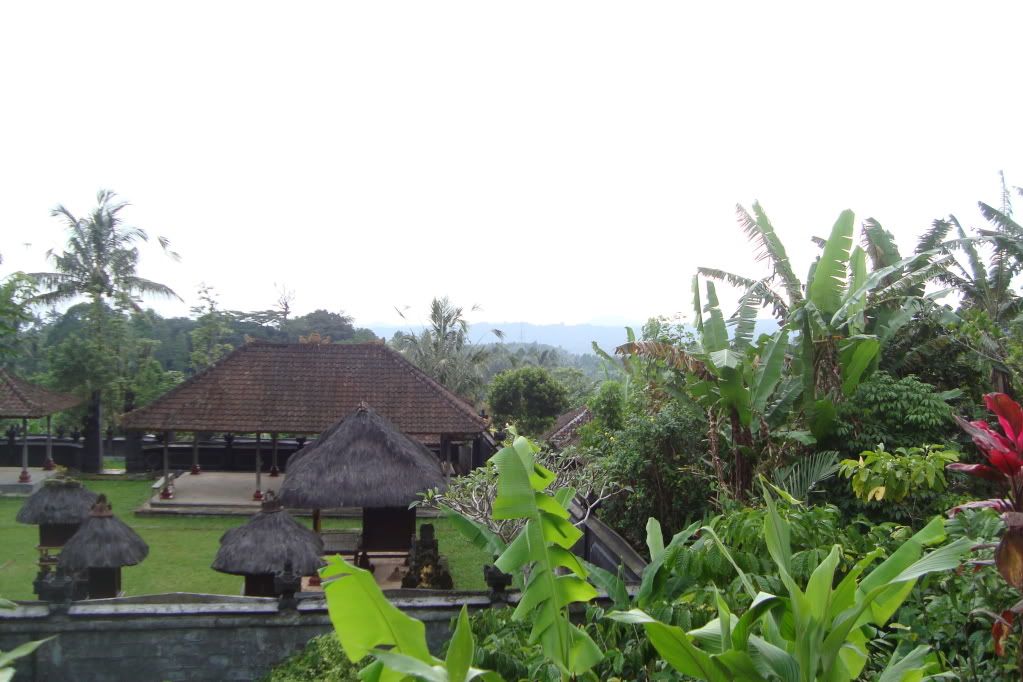 |
| Fresh air and Inspiring views from the front doorstep |
The house is small, just 6 x 9 metres in total, on a level land parcel of 200m2 constructed of blocks made of volcanic tuff and cement, lined with woods harvested from local agroforests, and roofed with locally made clay tiles. 2 bedrooms, lounge and a central thoroughfare. Kitchen and bathroom to one side.
The Roof was leaking and termites had caused a collapse in the kitchen. The roof was Asbestos sheeting. I could see this was no quick fix! but i bought in anyway..The prospect of a retreat in such a beautiful place with such peace and safety was too much to pass up. And then of course was the possibility to build a garden! Climates and soils like this in Australia are extremely rare and priced at a premium, id never get this chance at home!
Repairs began soon. All the roof sheeting was removed carefully and placed aside, the timbers were all removed and burned and replaced with New timbers. Local woods were sourced such as old coconut for the doorways, old coconut has a beautiful grain, Dark and speckled. An Albizzia species was used as battens. Some mahogany forms secondary support and a third unidentified wood with a rich red colour not unlike true american mahogany forms the main beams. In time i will plant replacement timbers on adjacent land to replace all wood in the house when the time comes with timber of higher quality, but thats another blog to write up!
The roof went on in January consisting of a good quality fired terracotta tile manufactured near tabanan. Tiles need to be carefully selected and painted with a waterproof paint before being laid. The higher quality the tile the better waterproofing ability and longer life of the support timbers and furniture below! heavy rain and ceremonial duties delayed the roof but this is expected in any building project.
Work like this is very cheap compared to Australia and the aesthetic outcome is unparalelled. It is my intention to restore this old girl to a condition higher than its original and retrofit it with some appropriate technologies that improve comfort while fitting seamlessly with the local traditional and emerging local style.
The roof went on in January consisting of a good quality fired terracotta tile manufactured near tabanan. Tiles need to be carefully selected and painted with a waterproof paint before being laid. The higher quality the tile the better waterproofing ability and longer life of the support timbers and furniture below! heavy rain and ceremonial duties delayed the roof but this is expected in any building project.
Work like this is very cheap compared to Australia and the aesthetic outcome is unparalelled. It is my intention to restore this old girl to a condition higher than its original and retrofit it with some appropriate technologies that improve comfort while fitting seamlessly with the local traditional and emerging local style.
 |
| A local House, newly built, showing the design and aesthetic common for local buildings for those with the means to do so. The design incorporates Cultural and practical design for this very Humid but sometimes cool climate. |
Work continues on restoration, time was needed to ensure the roof did not leak and allow all timbers and walls to dry out thoroughly after being exposed to rain. It was lucky i took this go slow approach as the roof does leak in places. A loose tile and improperly sealed tiles are the causes and are being rectified with adjustmnet and a second coat of waterproofing paint.
The next tasks will be the internal and external rendering of the block walls using sand and cement. There needed to be an adjusting of door heights upwards 20cm to accomodate my taller frame, and that of the average European male. From my short travels in Java i noticed the Balinese to be a taller and more robust people, and im sure a few of them would also hit their heads on the original doorways! The next step will be the fitting of new internal and external doors, nice and sturdy and made of all local materials that support growers and crafts people to maintain their skills. Finally we will be completing the ceramic tiling throughout the house. Its practicality to tile in this terrain, the red volcanic earth is most easily washed from a sealed hard surface. Mould is controlled by admitting UV light via glass tiles, by ventilation and by the used of clove oil in washing walls, an all natural strategy!
Retrofitting for environmental health and comfort will include replacing some clay tiles with clear or frosted glass tiles, and some bricks with glass bricks to remove the need for use of electric light during the day. Fortunately a government susbisdized scheme is underway in the local area to supply power to these houses with 900W power supply. This will allow use of LED lighting, a low wattage refrigeration unit, ceiling fan and charge points for Radio, battery lamps, mobile phones and laptops. Hot water will be an imported continuous supply Gas unit, no storage tank, fitted to LPG. The tap water itself is supplied from the higher slopes of the volcano and is clean not requiring treatment, like the air up there it is crisp and pure.
With the frequency of heavy cloud cover solar power is not an option. The area has a lot of potential for village scale small hydroelectric, and the region has untapped geothermal reserves. A small locally manufactured solar water heater could be built if cheap enough to justify its infrequent use. Perhaps a chip heater using small locally abundant and available agricultural waste would be most appropriate. Biogas or syngas are other options, and these are things i will try in future once all other household economies are brought to full efficency.
When the time comes ill fit the house with furniture garnished from local bamboo villages that make beds and other items from domestic bamboo, and from shops that sell recycled furniture, hopefully i can hold out for antiques.. Old teak and other wooden items from colonial and later 20th century styles.
So with the house gradually regaining livability my attention turns to the garden, the icing on the cake..and we all really know its the card that draws me!
My Garden
Situated in an area that is a classic example of Indonesias home gardens and complex agroforests it is paradise for an enthusiast and ethnobotanist like myself. The surrounding farms consist of shade grown Balinese Robusta coffee, of which i have been shown at least 3 distinct varieties. Among this are stands of Cacao for chocolate, Javanese and Cassia cinnamon, Nutmegs, Cloves, Vanilla, Citrus, Mangosteen, Durian, Salak palm, Coconut and numerous other minor cash and susbsistence species. A full inventory has not been made but it is a task i will relish.
Home gardens are usually seen as stepping off points for the domestication process. Wherever i go keen gardeners will be able to show me plants they have collected in local forests, nearby regions or from their travels of friends far abroad. This village is no different and my friends gardens show all this, with trials and experimnets and horticultural oddities all in varying stages of investigation.
Crime is pretty low level in such a small community, but it does happen. Less likely to be something large or expensive, your car is safe, as are building supplies. When chickens go missing its the talk of the village! But bring a rare plant and it may pay to establish it in a friends home garden first! I know well the allure of a rare or exotic plant, and even the mostly ethical practice of appropriating cuttings can be fatal if the plant is too small and there are too many fingers! Quietly.. this puts a smile on my face :) Ive lived my whole life in societies that treasure a Television, CD's or Bicycles, mass produced short term use throw away items, yet are blind to ethnobotanical value of my amazing plants. Not that anytjing has ever been taken! my friends just warned me as precaution, and i was flattered!! not offended!!
The plant in question is a Javanese medicinal pepper, Red betel (Piper crocatum), one of several Betel peppers and one of the more rare. http://www.sbsymphony.org/2010/03/the-benefits-of-red-betel-leaves/ and http://herbal.medicalonlinemedia.com/2009/09/red-betel-vine-benefit-for-health-beauty/. The Leaves of the Green betel (Piper Betel) along with turmeric and tamarind paste are boiled to make an everyday herbal drink for women that is renowned to maintain and enhance her sexual prowess, especially after childbirth.
I encourage locals to come and get cuttings. Ill be planting my most useful and rarest indonesian medicinal plants in reach of pathways and i hope people take home seed and cuttings to grow and use.
The garden is to be a launching pad, in the traditional sense, to experimnet with endemic, local, national and international collections of planst useful to the community and the economy. Despite their ecological sustainability the price of rolling out these large scale agroforests is the duplication effect leading to too much coffee, too much chocolate, too much cinnamon. depressed commodity prices, predatory buying practices by middlemen and to top it off disease pressures can lead to a point where it becomes uneconomical to continue.
Balinese landholder have been fortunate that the land prices have skyrocketed in recent years due to interest from developers catering to Villas and tourist markets. Asian investors have also bought in and intensified agriculture of a few species like coffee and citrus. This is often done in a way that destroys the complex fabric of these mixed forests. while outputs of cash commodities increase, the lions share goes offshore while the forest base that sustains the all important non cash economy for locals is eroded. fodder for animals, bamboos and timbers for building are sacrificed for short term gain.
An alternative strategy may be diversification. Because selling your land is a fast track to poverty of future generations and loss of sovereignty. But in the current setting these villages are land rich and cash poor, somethings needs doing. This is an ongoing process and doesn't exclude the growth of short term cash crops. Identifying missed opportunities for specialty timbers, Medicinal and food crops and forage crops is may aim. Co-operation is the key, locals taking care of labour and local ecological knowledge, and foreign partners like myself using our abilities to access planting material from across the globe held in collections or wild sourced, and then to link those products as closely as possible through few hands to the end consumer.
As an Amateur and keen ethnobotanist there is a process of learning where i listen and take in and decode the local understandings , needs and desires, and then try and contribute back to fill in gaps in both education and access to new planting materials. Learning about the cultural and dietary practices of the local area is very rewarding. Locals are always keen to have me try a local speciality, and i always accept. I will cover some of these treats later, wierd and wonderful to outsiders like me, some things i have only read about, and others that come as complete surprise. Local farmers are very competent in their ethnobotanical knowledge of the systems they create and very pleased to engage outsiders who take an interest and can return knowledge.
They are proud of their culture and love to share names and uses, and in return i can more than often tell them of names used by other groups as well as uses they were not aware of. In East java after being shown the traditional rice harvesting process, i reached down and started grazing on a spicy herb from a roadside cut. This immediately interested the villagers who gathered in to see what i was eating, its was Peperomia pellucida, a crisp and spicy 'weed' that is common across the tropics, and a bane of nurseries as it loves to grow in pots. The locals had no idea it was edible and no name for it, i assured them it was safe, popular in Vietnam, and helped myself to more. An old lady, and then a man jostled through and joined me, tentativetly, in testing this new herb. I told them its good but best mixed, campur, with other greens. Ethnobotany is a 2 way process, first you learn all you can, and the more you know and can share back, the more even the relationship gets and that makes everyone happy!
Ill continue next time looking at the species already in my garden, and those i am collecting for it. Itll be a mix of Balinese, Indonesian and international ethnobotany and a story of how gardeners exchanging information and planting materials across the world is improving the future for everyone.
, ,
 |
| Flat tiles and capping tiles were given one coat of a waterproofing paint. This should last 6 to 10 years. One coat proved insufficient and a second coat was applied and which accomplished the main goal of a sealed roof :) |
 |
| The Roof headpiece was selected by my good brother, I Wayan Joni. In Hindu tradition the Ancient Swastika symbol is associated with good luck and wellbeing. It is related to the traditional balinese greeting, Om Swasti Astu - meaning may the divine grant you health and wellbeing. |
The next tasks will be the internal and external rendering of the block walls using sand and cement. There needed to be an adjusting of door heights upwards 20cm to accomodate my taller frame, and that of the average European male. From my short travels in Java i noticed the Balinese to be a taller and more robust people, and im sure a few of them would also hit their heads on the original doorways! The next step will be the fitting of new internal and external doors, nice and sturdy and made of all local materials that support growers and crafts people to maintain their skills. Finally we will be completing the ceramic tiling throughout the house. Its practicality to tile in this terrain, the red volcanic earth is most easily washed from a sealed hard surface. Mould is controlled by admitting UV light via glass tiles, by ventilation and by the used of clove oil in washing walls, an all natural strategy!
 |
| The original interior showing tiled floors, hardwood window frames, Open vents above windows and rendered walls. The darkness has been adjusted by installing a glass tile to admit light, and while vents will remain open i will be fitting a fine "midge" grade insect gauze screen to fit in the recess so allowing air but not insect movement! |
Retrofitting for environmental health and comfort will include replacing some clay tiles with clear or frosted glass tiles, and some bricks with glass bricks to remove the need for use of electric light during the day. Fortunately a government susbisdized scheme is underway in the local area to supply power to these houses with 900W power supply. This will allow use of LED lighting, a low wattage refrigeration unit, ceiling fan and charge points for Radio, battery lamps, mobile phones and laptops. Hot water will be an imported continuous supply Gas unit, no storage tank, fitted to LPG. The tap water itself is supplied from the higher slopes of the volcano and is clean not requiring treatment, like the air up there it is crisp and pure.
 |
| The exposed bathroom after roof removal. The cistern overflowing due to leak is fixed, its called a Mandi and water is bucketed from it to wash or flush using a ladle. The Asian style squat toilet is very healthy and easy to adjust to. A shower head and wash basin will be installed fitted to an instantaneous gas water heater from the kitchen. The window filled with opaque glass bricks and the walls rendered, surfaces tiled... and a towel rack in there too ;) |
With the frequency of heavy cloud cover solar power is not an option. The area has a lot of potential for village scale small hydroelectric, and the region has untapped geothermal reserves. A small locally manufactured solar water heater could be built if cheap enough to justify its infrequent use. Perhaps a chip heater using small locally abundant and available agricultural waste would be most appropriate. Biogas or syngas are other options, and these are things i will try in future once all other household economies are brought to full efficency.
 |
| Original state |
 |
| Roof approaching restoration.. |
So with the house gradually regaining livability my attention turns to the garden, the icing on the cake..and we all really know its the card that draws me!
My Garden
Situated in an area that is a classic example of Indonesias home gardens and complex agroforests it is paradise for an enthusiast and ethnobotanist like myself. The surrounding farms consist of shade grown Balinese Robusta coffee, of which i have been shown at least 3 distinct varieties. Among this are stands of Cacao for chocolate, Javanese and Cassia cinnamon, Nutmegs, Cloves, Vanilla, Citrus, Mangosteen, Durian, Salak palm, Coconut and numerous other minor cash and susbsistence species. A full inventory has not been made but it is a task i will relish.
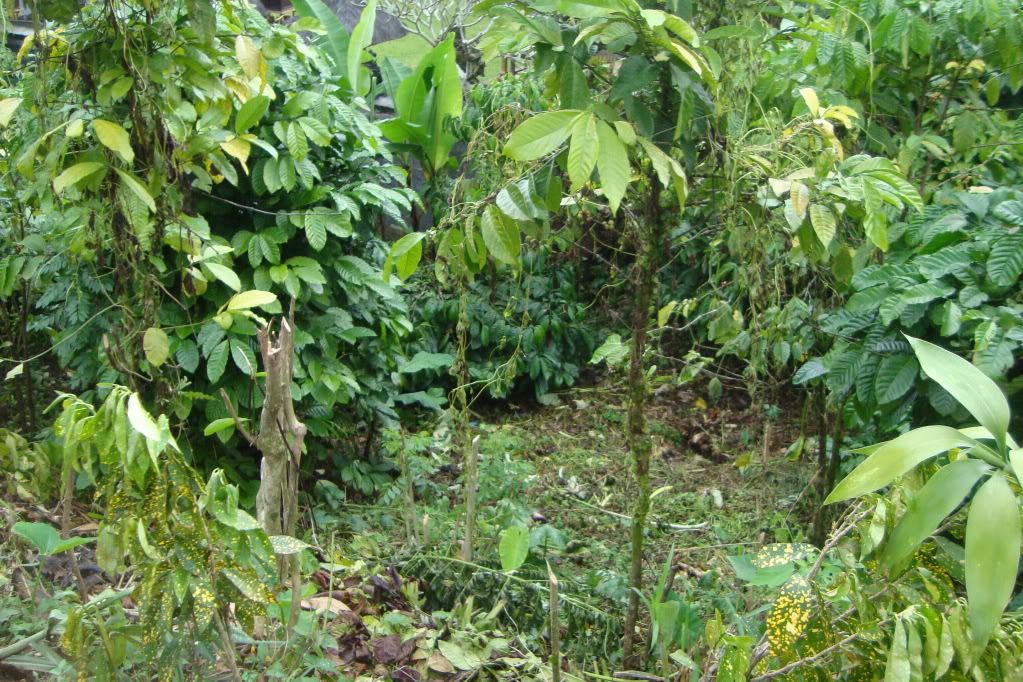 |
| Rich soils support Healthy coffee plantations with overstorey of legume shade trees and a herbaceous understory that are trimmed to feed tethered Bali cattle, goats and pigs. Poultry free range in gardens close to the house while further afield roam wildlife including Luwak and Green junglefowl. |
Home gardens are usually seen as stepping off points for the domestication process. Wherever i go keen gardeners will be able to show me plants they have collected in local forests, nearby regions or from their travels of friends far abroad. This village is no different and my friends gardens show all this, with trials and experimnets and horticultural oddities all in varying stages of investigation.
Crime is pretty low level in such a small community, but it does happen. Less likely to be something large or expensive, your car is safe, as are building supplies. When chickens go missing its the talk of the village! But bring a rare plant and it may pay to establish it in a friends home garden first! I know well the allure of a rare or exotic plant, and even the mostly ethical practice of appropriating cuttings can be fatal if the plant is too small and there are too many fingers! Quietly.. this puts a smile on my face :) Ive lived my whole life in societies that treasure a Television, CD's or Bicycles, mass produced short term use throw away items, yet are blind to ethnobotanical value of my amazing plants. Not that anytjing has ever been taken! my friends just warned me as precaution, and i was flattered!! not offended!!
The plant in question is a Javanese medicinal pepper, Red betel (Piper crocatum), one of several Betel peppers and one of the more rare. http://www.sbsymphony.org/2010/03/the-benefits-of-red-betel-leaves/ and http://herbal.medicalonlinemedia.com/2009/09/red-betel-vine-benefit-for-health-beauty/. The Leaves of the Green betel (Piper Betel) along with turmeric and tamarind paste are boiled to make an everyday herbal drink for women that is renowned to maintain and enhance her sexual prowess, especially after childbirth.
 |
| Red betel pepper (Piper crocatum) is a Javanese medicinal species i missed collecting when in Java but managed to locate in bali from a specialist collector at the "exorbitant" price of $AUD 6. It is used in traditional preparations for heart troubles, hypertension, halitosis, diabetes, womens medicine and as an antitussive. |
 |
| Red Betel is sought after as an ornamental in addition to its medicinal value. |
The garden is to be a launching pad, in the traditional sense, to experimnet with endemic, local, national and international collections of planst useful to the community and the economy. Despite their ecological sustainability the price of rolling out these large scale agroforests is the duplication effect leading to too much coffee, too much chocolate, too much cinnamon. depressed commodity prices, predatory buying practices by middlemen and to top it off disease pressures can lead to a point where it becomes uneconomical to continue.
Balinese landholder have been fortunate that the land prices have skyrocketed in recent years due to interest from developers catering to Villas and tourist markets. Asian investors have also bought in and intensified agriculture of a few species like coffee and citrus. This is often done in a way that destroys the complex fabric of these mixed forests. while outputs of cash commodities increase, the lions share goes offshore while the forest base that sustains the all important non cash economy for locals is eroded. fodder for animals, bamboos and timbers for building are sacrificed for short term gain.
An alternative strategy may be diversification. Because selling your land is a fast track to poverty of future generations and loss of sovereignty. But in the current setting these villages are land rich and cash poor, somethings needs doing. This is an ongoing process and doesn't exclude the growth of short term cash crops. Identifying missed opportunities for specialty timbers, Medicinal and food crops and forage crops is may aim. Co-operation is the key, locals taking care of labour and local ecological knowledge, and foreign partners like myself using our abilities to access planting material from across the globe held in collections or wild sourced, and then to link those products as closely as possible through few hands to the end consumer.
As an Amateur and keen ethnobotanist there is a process of learning where i listen and take in and decode the local understandings , needs and desires, and then try and contribute back to fill in gaps in both education and access to new planting materials. Learning about the cultural and dietary practices of the local area is very rewarding. Locals are always keen to have me try a local speciality, and i always accept. I will cover some of these treats later, wierd and wonderful to outsiders like me, some things i have only read about, and others that come as complete surprise. Local farmers are very competent in their ethnobotanical knowledge of the systems they create and very pleased to engage outsiders who take an interest and can return knowledge.
They are proud of their culture and love to share names and uses, and in return i can more than often tell them of names used by other groups as well as uses they were not aware of. In East java after being shown the traditional rice harvesting process, i reached down and started grazing on a spicy herb from a roadside cut. This immediately interested the villagers who gathered in to see what i was eating, its was Peperomia pellucida, a crisp and spicy 'weed' that is common across the tropics, and a bane of nurseries as it loves to grow in pots. The locals had no idea it was edible and no name for it, i assured them it was safe, popular in Vietnam, and helped myself to more. An old lady, and then a man jostled through and joined me, tentativetly, in testing this new herb. I told them its good but best mixed, campur, with other greens. Ethnobotany is a 2 way process, first you learn all you can, and the more you know and can share back, the more even the relationship gets and that makes everyone happy!
Ill continue next time looking at the species already in my garden, and those i am collecting for it. Itll be a mix of Balinese, Indonesian and international ethnobotany and a story of how gardeners exchanging information and planting materials across the world is improving the future for everyone.
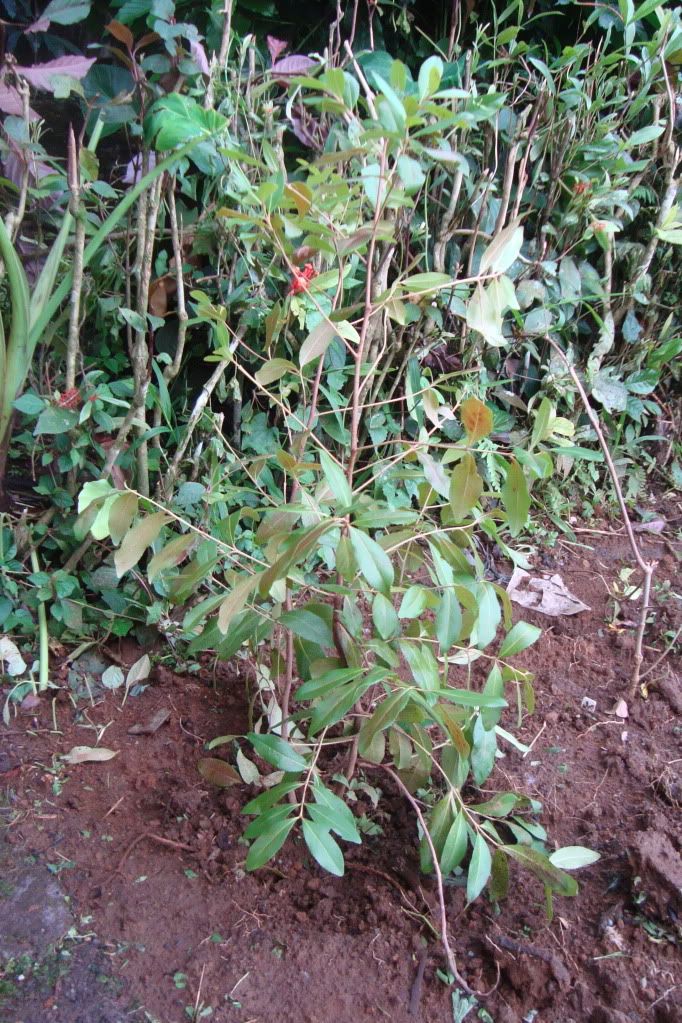 |
| Catha edulis Narrow leaf form. Possibly a hybrid of Red and Narrow leaf forms. Intended for use as a hedge. |
, ,
Tuesday, September 7, 2010
Catha edulis, from Coolbellup to Candi Kuning
In a suburb near Fremantle, Western australia in 2002 we located a large Khat tree (Catha edulis), a stimulant commonly used in East Africa, The Arab Gulf states and Madagascar. Its is a Medium sized tree most often found as a highly pruned shrub that is grown for its fresh shoots which contain the stimulants Cathinone and Cathine.
These trees were and may still be somewhat common in the older suburbs of Perth, Western Australia. Our investigations through local nurseries suggest that its was propagated by nurserymen over a number of decades beginning in the late 1950's as an ornamental plant. It suits the soils and climate well and it is indeed and attractive garden plant resembling in many horticultural features the Photinia.
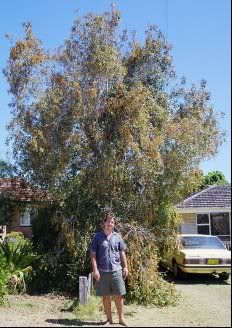 |
| Figure 1: The Mother lode Tree 2002. This is the largest seed load we have ever seen on a Khat tree. This tree has now been felled |
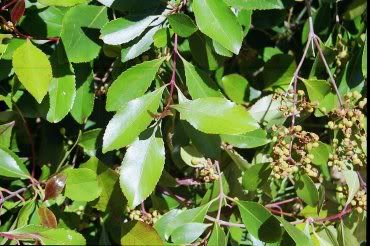 |
| Figure 2: The Foliage of the type of Khat trees common in the suburbs of Perth. |
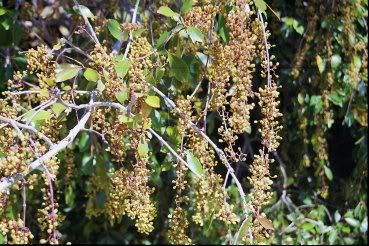 |
| Figure 3: Seed pods as they hang in clusters from the tree |
We were then surprised to find a large tree in a friends grandmothers backyard in and old Perth suburb, so i sent a pressed sample to my colleague who confirmed its identity, with equal surprise. I was to find several more trees during my time in Perth, and hear of a great deal more.
It was in 2002 while cycling to Fremantle that i spotted two east African looking gentlemen high up a tree. This being the tree pictured in Figures 1 -3, from which i had already been collecting seed the week before. I approached them to say hello and hopefully learn more about its use.
At first they were hesitant, but when it became clear i was familiar with this tree they opened up. These fellows were from Kenya and were harvesting for themselves and their Ethiopian friends. They chew it socially with friends, listen to music and drink some beers. This seemed a more informal ritual than the Qat houses of Somalia and Yemen, where the Islamic customs exclude Alcohol.
These fellows told me of how they used to grow it in the moist fertile highlands, renting land between Coffee plantations in order to grow Khat. By digging a hole and planting cuttings they would establish trees that could be first harvested some 3 or 4 years later, not unlike the timespan to grow coffee itself.
When queried on seeds, they told me unequivcally that Khat does not grow from seed, as they stood against a backdrop of a seed laden tree. I understood this though as it is a common understanding with many crops that they are not grown from seed if a cutting will bear more quickly and reliably, this is the undertanding ofthe farmer, not the biologist like me, who is most interested in aspects other than yield.
This tree, they told me, was poorly managed - too big! The leaves were tough and weak, a good tree would be pollarded, that is cut off much lower and encouraged to reprout vigorously. It is these juicy crisp and low tannin shoots that are most valued.
I never saw those men again, though i spoke to the owner a few years later and the tree had been savagely pruned. The owner was dismayed at the Car loads of Africans who would turn up in the front yard any time of day or night climing the tree and taking away branches. He was concerned about litigation ifthey hurt themselves and was intending to remove the tree. Sadly this story is common, many trees i have known, and many people have told me their stories of their Africans in the trees, despair and eventual arboricide.
Those seeds however were distributed Australia wide and Worldwide.
I had the opportunity to taste some quality shoots in Perth from a recently coppiced tree. The flavour and texture was indeed far better, slight tannins and sweetness like sucking on a teabag. And a pleasant aromatic flavour. The effects were subtle but definite. Those expecting Amphetamine should be ready to be disappointed! firstly one has to chew some 150 - 300g of fresh shoots, a hefty amount to the unaccustomed!
The tannins are still present and so pucker the mouth.
The effect i can liken to Strong cup of Tea, and in exactly the same way it relaxes and invigorates. Chemically it may be amphetamine but its effects are so mild that only chemists need care. It enlivens conversation without inebriating, it is pleasing, but the cost, that of chewing so much herbage im sure will restrict its use to ethnic circles.
The compound itself is unstable, and extremely difficult to extract and stabilize. Even dried leaves only contain the weaker Cathine, perhaps useful in weight loss or congested sinus. As a starting point for drug synthesis the plant is a dead end.
Cathinone is not the same as Methcathinone, a street drug manufactured from Sinus pills and much stronger and more stable. Nicknamed "Cat" or "Kitty" this im sure has led to confusion among law makers and they have now banned the plant in two Australian states. So this plant becomes an unfortunate casualty of the War on Drugs, which is silly, because it is really the same as banning Coffee, Chocolate and Tea plants in what it achieves, while all the street drugs are made from Pharamceuticals.
Part two
In 2003 We travelled to Bali, Indonesia, to explore the Island for a month. Part of this exploration took us to the Bali Kebun Raya (Botanical gardens) at Candi kuning near Bedugul in the Mountains.
We took with us on our trip seeds of the Khat tree and donated them to the Botanic gardens.
Part 3
I returned and relocated to New South Wales where i continued a long running interest in Khat. On the east coast the plants were much more rare, but multiple forms existed.
There were even some collectors beginning to cross pollinate specimens and create horticultural hybrids.One such hybrid is the Cultivar Vienna white, a hybrid of the Red and Green forms of Khat (figure 4), This was bred by a collector know as "Planthelper" living near bangalow, west of Byron Bay on the Northern New South Wales coast.
Nearby close to Lismore, NSW are Narrow leaved forms of the same species that look very different (fig 5 & Fig 6). These appear to originate more in the Southern range of the species and can be found in South Africa where they are also used (van Wyk & Gericke 2003).
Other species have also been grown and may contain similar compounds to Catha, such as the widespread genus Maytenus.
In 2009/2010 Hybrid seed of the Red and Narrow leaf Catha edulis became available.
When we returned to Bali in December 2009 we were pleased to find fellow plant collectors there had Khat trees amongst their collections.When queried about its origin we found it was sourced from the Kebun Raya and so we returned to the gardens after 7 years and easily located the thriving tree in the Medicinal herb gardens.


This has confrmed to us the value of Amateur plant collectors giving back to Public gardens, not just in your own country but when travelling abroad.
It is our intention to continue to donate seeds and plants of useful species to public gardens worldwide and assist in their dissemination and studyWe took with us on our trip seeds of the Khat tree and donated them to the Botanic gardens.
Part 3
I returned and relocated to New South Wales where i continued a long running interest in Khat. On the east coast the plants were much more rare, but multiple forms existed.
There were even some collectors beginning to cross pollinate specimens and create horticultural hybrids.One such hybrid is the Cultivar Vienna white, a hybrid of the Red and Green forms of Khat (figure 4), This was bred by a collector know as "Planthelper" living near bangalow, west of Byron Bay on the Northern New South Wales coast.
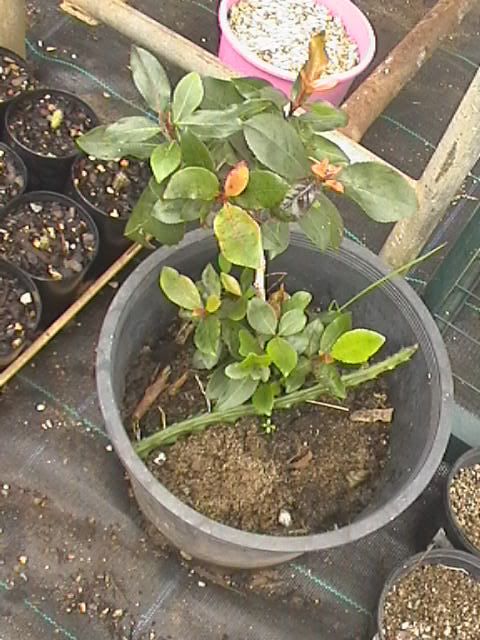 |
| Figure 4: A "Vienna White" hybrid of the Red and Green forms bred near Bangalow NSW |
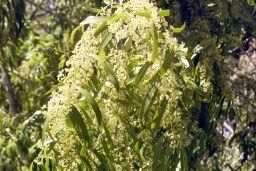 |
| Figure 5: The Narrow Leaf form of Catha edulis from Southern Africa |
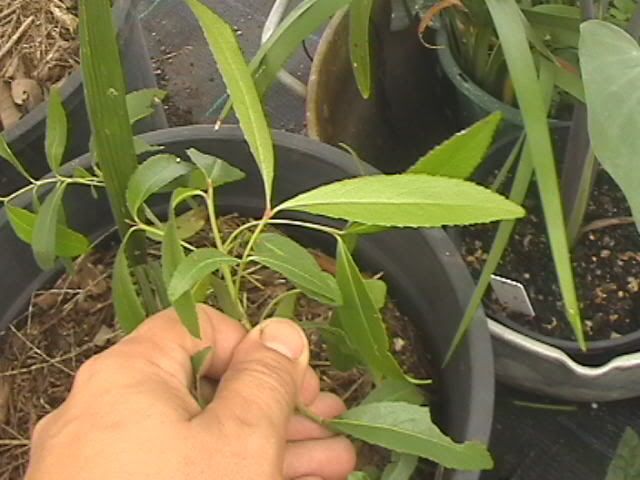 |
| Figure 6: The Narrow leaf form of Catha edulis showing leaf type |
Other species have also been grown and may contain similar compounds to Catha, such as the widespread genus Maytenus.
In 2009/2010 Hybrid seed of the Red and Narrow leaf Catha edulis became available.
When we returned to Bali in December 2009 we were pleased to find fellow plant collectors there had Khat trees amongst their collections.When queried about its origin we found it was sourced from the Kebun Raya and so we returned to the gardens after 7 years and easily located the thriving tree in the Medicinal herb gardens.
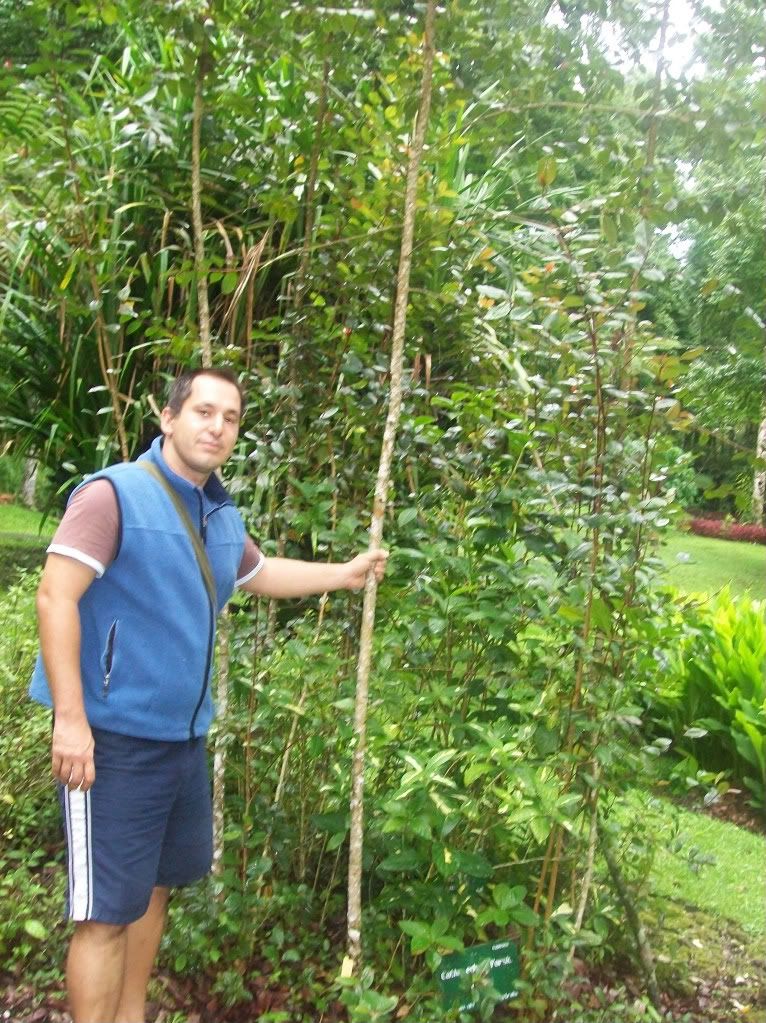
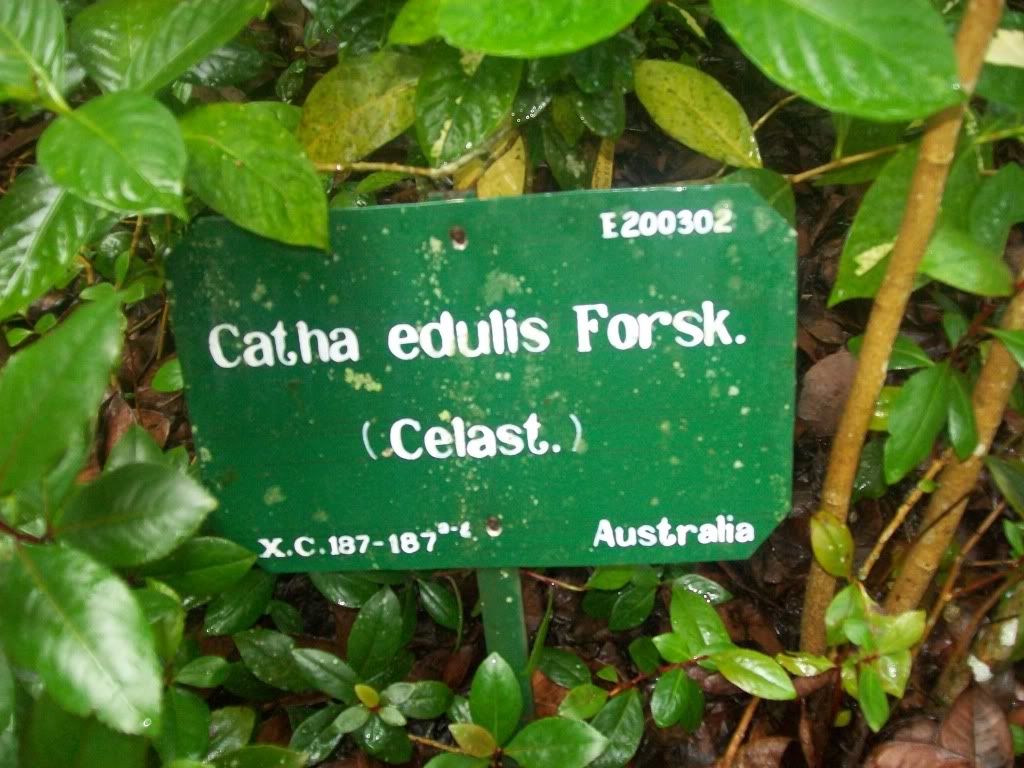
This has confrmed to us the value of Amateur plant collectors giving back to Public gardens, not just in your own country but when travelling abroad.
References
van Wyk, B. & Gericke, N. (2003). People's Plants: A Guide to Useful Plants of Southern. Africa. Briza Publications, Pretoria, South Africa
Reccomended reading
Rushby K. 1999. Eating the Flowers of Paradise: One Man's Journey Through Ethiopia and Yemen
qat page
http://www.al-bab.com/yemen/soc/qat.htm
Ka'apor Forest Ethnobotany
Footprints of the Forest: Ka'Apor Ethnobotany- The Historical Ecology of Plant Utilization by an Amazonian People (Biology and Resource Management I)
Some Titles we've hand selected in refernce to this Post
Some Titles we've hand selected in refernce to this Post
Monday, September 6, 2010
300 year old Food forest in Vietnam
300 year old Food forest in Vietnamese Suburb
Geoff lawton discovers a 300 Year old Garden tended by a Vietnamese family for 28 generations.
I love this Clip because i too search out old suburbs and where i always find the most interesting plants and emergent ecologies.
Old soils built up layer by layer from gardening and human activity, with Domestic plants and animals that have thrived over centuries of climatic variation. In Australia this situation is easy to find but like everywhere becoming a more and more scarce resource as cities intensify and modernize.
Old Public gardens are also very valuable for the Permaculture designer as they provide not only the tried and tested propagation material to start new gardens, but also the knowledge of what mature plants look like, their accumulated community of associated plants, wildlife and soil biota.
Finding an ancient Oak or mulberry, or in the tropics a 100 year old Mango tree allows you to study what each tree does to the soil in which it grows and the plant nutrients, deep profile soil carbon qualities, or surface O-Horizon "duff" or the allellotoxins that species may bioaccumulate. A native example i recall from Fremantle is the community that forms about rottnest Island Pines (Callitris preissii), whoe duff and possibly allelotoxins create a habitat that allows the growth of a Pellitory herb, which in turn is the sol food source of the Blue skipper Butterfly. We do not yet know what range of special habitats exotic species are creating that will foster unique niches for increased biodiversity, although we have evidence that Old Moneterey/Radiata Pine groves provide a rich habitat for rare native Ferns, Mosses and terrestrial orchids. These habitats then also support the species that depend on these plants. The importance of Mature pines to endangered Black cockatoos is well known, and Urban Mango trees are well utilised by endangered fruit bats and local bird species.
Old trees in mature urban settings allow study of how exotic plants integrate into the ecology and how they interact with native species and provide valuable habitat. What kinds of lichen,moss, algae, vascular epiphytes and fungi adapt to its bark? What invertebrate diversity lurks among the canopy, on the bark and in the rootzone? What structural diversity does it provides for nesting or feeding Birds, Mammals or reptiles, and what epiphytes like to settle. And to humans what are the properties for Ammenity planning? Shade? longevity? root stability, spread and invasiveness?. Without this evidence a designer cannot design systems that are truly sustainable.Without real examples to survey and quantify we remain in the dark working with a very rudimentary theory based approach to Urban ecosystem design.
These old gardens are of immense value, not only because we are working with species that do not occur naturally together, being separated by geographic boundaries, but also because many of our most valuable cultivated species are becoming very rare or are already extinct in truly wild settings. Wild Apples in Afghanistan or Wild Vanilla in mexico are on the verge of disappearing before we know how their original ecosystems worked.
Geoff lawton discovers a 300 Year old Garden tended by a Vietnamese family for 28 generations.
I love this Clip because i too search out old suburbs and where i always find the most interesting plants and emergent ecologies.
Old soils built up layer by layer from gardening and human activity, with Domestic plants and animals that have thrived over centuries of climatic variation. In Australia this situation is easy to find but like everywhere becoming a more and more scarce resource as cities intensify and modernize.
Old Public gardens are also very valuable for the Permaculture designer as they provide not only the tried and tested propagation material to start new gardens, but also the knowledge of what mature plants look like, their accumulated community of associated plants, wildlife and soil biota.
Finding an ancient Oak or mulberry, or in the tropics a 100 year old Mango tree allows you to study what each tree does to the soil in which it grows and the plant nutrients, deep profile soil carbon qualities, or surface O-Horizon "duff" or the allellotoxins that species may bioaccumulate. A native example i recall from Fremantle is the community that forms about rottnest Island Pines (Callitris preissii), whoe duff and possibly allelotoxins create a habitat that allows the growth of a Pellitory herb, which in turn is the sol food source of the Blue skipper Butterfly. We do not yet know what range of special habitats exotic species are creating that will foster unique niches for increased biodiversity, although we have evidence that Old Moneterey/Radiata Pine groves provide a rich habitat for rare native Ferns, Mosses and terrestrial orchids. These habitats then also support the species that depend on these plants. The importance of Mature pines to endangered Black cockatoos is well known, and Urban Mango trees are well utilised by endangered fruit bats and local bird species.
Old trees in mature urban settings allow study of how exotic plants integrate into the ecology and how they interact with native species and provide valuable habitat. What kinds of lichen,moss, algae, vascular epiphytes and fungi adapt to its bark? What invertebrate diversity lurks among the canopy, on the bark and in the rootzone? What structural diversity does it provides for nesting or feeding Birds, Mammals or reptiles, and what epiphytes like to settle. And to humans what are the properties for Ammenity planning? Shade? longevity? root stability, spread and invasiveness?. Without this evidence a designer cannot design systems that are truly sustainable.Without real examples to survey and quantify we remain in the dark working with a very rudimentary theory based approach to Urban ecosystem design.
These old gardens are of immense value, not only because we are working with species that do not occur naturally together, being separated by geographic boundaries, but also because many of our most valuable cultivated species are becoming very rare or are already extinct in truly wild settings. Wild Apples in Afghanistan or Wild Vanilla in mexico are on the verge of disappearing before we know how their original ecosystems worked.
Forest biochar
Biochar 101
Biochar or Agrichar is doing the rounds in the news as a solution to a range of problems, including declining soil health and Carbon dioxide emissions from Industry and Agriculture.
Biochar is created by burning organic materials in low oxygen conditions so that a proportion of the carbon does not escape as Waste gases but stays behind as a solid and relative inert form of carbon we commonly know as Charcoal. The lack of sufficient oxygen prevents combustion to the end point where only mineral salts remain, known as Ash. Ash contains plant nutrients but it is caustic and water soluble so what canot be used quickly leaches away.
Most Charcoal is produced for industrial and fuel uses and ends up being burned anyway.The better industrial charcoal is made from Trees either in plantation or from felling natural forests. In this setting Charcoal is a great waster of a natural resource, as only 15-35% of the Carbon in Wood is retained in the marketable product.
However, Change the intent and feed stock origin and the whole game changes. Better Biochar is made from Low value organic wastes such as husks, shells, sawdust, short fibres, cleared brush and palm wastes to name a few, interfere greatly with cropping and tillage or general operations in Farming, Industry and forestry. They are generally low in plant nutrients and so naturally slow to break down, they do add some soil organic matter but often with great nuisance. They may contain inhibitory compounds that retard the growth of the next crop, or may harbour disease for the next season. Left to compost naturally the loss of carbon is almost complete with very little joining long lasting slow soil carbon pools. Any organic gardener will lament the sheer quantities of mulches and manures they have carted onsite, only to see it swallowed up by the soil. There is benefit, but it is easily undone by a few years of neglect, and it is a constant struggle to build and mantain on farm soil organic matter. Because of this, carbon that can be fixed by conversion to stable black carbon is a highly efficient gain and not a waste.
One of the benefits of Biochar is that it joins a store of carbon that is extremely resilient and long lasting. Charcoal is used by archaeologists to date prehistoric human settlements, and seams of charcoal exist from when land plants had only recently evolved. Even today many ferns like charcoal in their potting mixes, or will not germinate in the wild unless there is charcoal in the seedbed.
Biochar complements other Active and passive pools of Carbon in the soil by improving soil structure and decreasing bulk density so that roots, fungi and soil fauna can move around more easily. Chemically it helps form aggregates that stabilize other soil organic matter against loss by oxidation.Biochar does not replace living soil and Humus, it protects and complements it!
In this way a yield from an annual harvest of waste Peanut hulls, converted to 20% of its volume in Char and re-incorporated represents a boom to stable soil carbon levels that is unheard of by any other means within that time frame. It is also produced onsite or nearby and so is not robbing peter to pay paul.
Because Biochar is bulky but light and full of pores, it decreases the heaviness to the soil, helps it hold more water and more air, and helps prevent tight compaction. In amongst these spaces are sticky chemical sites that hold onto plant nutrients and slow the leaching process.
The Video
The clips show a man in Hawaii using Biochar to turn a carbon rich but infertile site into a rich Garden.
Rank vegetation in degraded areas`after logging and regrowth offers a ready onsite source of carbon.
Using a simple method the materialis converted to a Biochar that enhances the local soil.
Our own method we developed several years ago is very much like this method. Its is Low tech, used onsite materials and apart from simple labour, which you supply yourself, is free.
Our own methods used more grasses, like lawn clippings, Vetiver, Bana grass, bamboos, as well as wood prunings and woody fruits pits and capsules from Fruit and ornamnetal trees. By Turning the Hard,noxious, diseased elemenst of the garden to char they are defused.
Now in the tropics the use of Palm wastes including fronds, seeds, sheathes and trunks is most appropriate.
Biochar 2
Biochar 3
Biochar or Agrichar is doing the rounds in the news as a solution to a range of problems, including declining soil health and Carbon dioxide emissions from Industry and Agriculture.
Biochar is created by burning organic materials in low oxygen conditions so that a proportion of the carbon does not escape as Waste gases but stays behind as a solid and relative inert form of carbon we commonly know as Charcoal. The lack of sufficient oxygen prevents combustion to the end point where only mineral salts remain, known as Ash. Ash contains plant nutrients but it is caustic and water soluble so what canot be used quickly leaches away.
Most Charcoal is produced for industrial and fuel uses and ends up being burned anyway.The better industrial charcoal is made from Trees either in plantation or from felling natural forests. In this setting Charcoal is a great waster of a natural resource, as only 15-35% of the Carbon in Wood is retained in the marketable product.
However, Change the intent and feed stock origin and the whole game changes. Better Biochar is made from Low value organic wastes such as husks, shells, sawdust, short fibres, cleared brush and palm wastes to name a few, interfere greatly with cropping and tillage or general operations in Farming, Industry and forestry. They are generally low in plant nutrients and so naturally slow to break down, they do add some soil organic matter but often with great nuisance. They may contain inhibitory compounds that retard the growth of the next crop, or may harbour disease for the next season. Left to compost naturally the loss of carbon is almost complete with very little joining long lasting slow soil carbon pools. Any organic gardener will lament the sheer quantities of mulches and manures they have carted onsite, only to see it swallowed up by the soil. There is benefit, but it is easily undone by a few years of neglect, and it is a constant struggle to build and mantain on farm soil organic matter. Because of this, carbon that can be fixed by conversion to stable black carbon is a highly efficient gain and not a waste.
One of the benefits of Biochar is that it joins a store of carbon that is extremely resilient and long lasting. Charcoal is used by archaeologists to date prehistoric human settlements, and seams of charcoal exist from when land plants had only recently evolved. Even today many ferns like charcoal in their potting mixes, or will not germinate in the wild unless there is charcoal in the seedbed.
Biochar complements other Active and passive pools of Carbon in the soil by improving soil structure and decreasing bulk density so that roots, fungi and soil fauna can move around more easily. Chemically it helps form aggregates that stabilize other soil organic matter against loss by oxidation.Biochar does not replace living soil and Humus, it protects and complements it!
In this way a yield from an annual harvest of waste Peanut hulls, converted to 20% of its volume in Char and re-incorporated represents a boom to stable soil carbon levels that is unheard of by any other means within that time frame. It is also produced onsite or nearby and so is not robbing peter to pay paul.
Because Biochar is bulky but light and full of pores, it decreases the heaviness to the soil, helps it hold more water and more air, and helps prevent tight compaction. In amongst these spaces are sticky chemical sites that hold onto plant nutrients and slow the leaching process.
The Video
The clips show a man in Hawaii using Biochar to turn a carbon rich but infertile site into a rich Garden.
Rank vegetation in degraded areas`after logging and regrowth offers a ready onsite source of carbon.
Using a simple method the materialis converted to a Biochar that enhances the local soil.
Our own method we developed several years ago is very much like this method. Its is Low tech, used onsite materials and apart from simple labour, which you supply yourself, is free.
Our own methods used more grasses, like lawn clippings, Vetiver, Bana grass, bamboos, as well as wood prunings and woody fruits pits and capsules from Fruit and ornamnetal trees. By Turning the Hard,noxious, diseased elemenst of the garden to char they are defused.
Now in the tropics the use of Palm wastes including fronds, seeds, sheathes and trunks is most appropriate.
Biochar 2
Biochar 3
Subscribe to:
Posts (Atom)


 Posts
Posts